[New post] Three UG scientists receive European grants worth millions
Giulia Fabrizi posted: " Three UG researchers have each been awarded an ERC Advanced Grant by the European Research Council. These grants can run up to 2.5 million euros for a period of five years and the researchers can use the money to set up long-term and ground-brea"
Three UG researchers have each been awarded an ERC Advanced Grant by the European Research Council.
These grants can run up to 2.5 million euros for a period of five years and the researchers can use the money to set up long-term and ground-breaking research projects. Maria Antonietta Loi, Bart van Wees, and Siewert-Jan Marrink are established academics with important research achievements.
Metamaterials
Loi's research is in opto-electronics, a field that focuses on the interaction of materials and light. She works with materials with specific structures on the nanometre scale. Loi would like to find out how nanostructures determine a material's characteristics and create nanostructures for specific applications.
Earlier, she worked on the development of a new type of solar cell, among other things. Her work for the ERC will involve creating so-called 'metamaterials'. These are materials that are designed and do not occur in nature. The materials she creates can be modulated to receive or emit light at specific wavelengths. Her end goal is to develop new infrared photodetectors and visible-light-emitting diodes of superior performance.
Spintronics
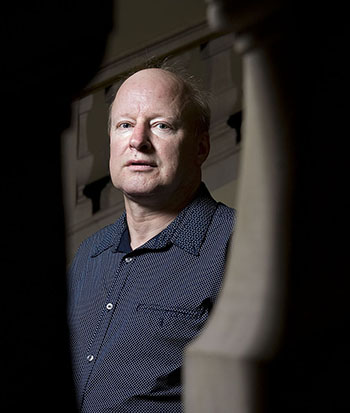
Photo by Reyer Boxem
Van Wees works in the field of 'spintronics', which uses the quantum mechanical property of electrons (also known as spin). Using graphene-based 2D equipment, he studies this magnetic property by manipulating and transporting spins. He's already used this technique to create a 'spin transistor'.
For his ERC project, he'll be working with 'magnons': spin waves in a non-conductive magnetic material. This is a disruption of the magnetisation which spreads like a wave in a full sports stadium: electrons in the material pass the spin on to their neighbours and then return to their original position. In this particular form of transport, only the spin moves, while the electrons stay in position. This does not generate any heat, which means the transport doesn't require very much energy.
According to the UG, this project opens up a world that has never been studied before. Van Wees will be studying the interaction between spins, magnons, and phonons in 2D equipment. His goal is to find new strategies for low-power information technology such as heat management.
Computer microscopy
Siewert-Jan Marrink works on computer simulations of molecules and atoms. One of the leading packages for research into molecular dynamics is the Gromacs software, which was developed at the UG. Marrink developed a much-used force field for this software, called the Martini model, which can significantly speed up simulations.
These simulations can uncover processes that aren't visible in experiments, such as the interaction between molecules and cell membranes. This is also known as computer microscopy. Marrink's goal is to first simulate a cell organelle, eventually simulating an entire cell. He hopes his ERC project will enable him to make great strides towards this goal, by being the first person to simulate a specific complete cell at molecular resolution, among other things.




No comments:
Post a Comment